Wren Kitchens: The art of the virtual showroom

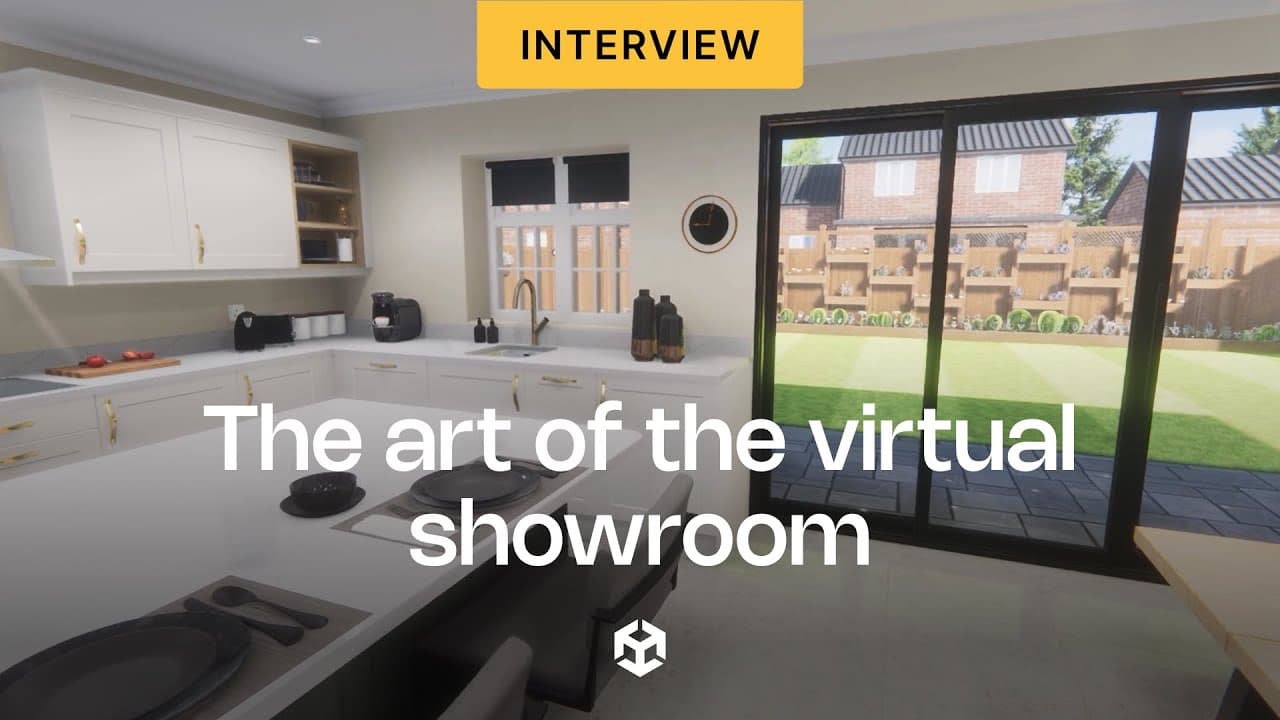
Use case
VR kitchen showroom & 3D planner
Industry
Retail, home improvement
Tech
Unity Industry, Asset Manager, Asset Transformer, VR
Impact
Increased customer confidence, positive correlation between VR experience and purchase
Katie Fisher, Technical Development Manager at Wren Kitchens, discusses how her team has embraced VR to address the challenge of giving customers the confidence to invest in a space that doesn’t exist yet. Discover how Katie discovered Unity, and how (and why) Wren Kitchens use Unity’s retail solutions to create their VR app ‘3D Planner’.
Transcript
I'm Katie Fisher. I'm the Technical Development Manager for Wren Kitchens and I lead 3D at Wren. My team produces the internal planning application Planner 3D and also produces marketing renders.
From gaming to kitchens
I originally wanted to become a games developer. I love video games. I still develop video games in my free time, mostly using Unity, funnily enough. I've always wanted to make virtual worlds. I have wanted to do that, I think, since playing Ocarina of Time on the N64 when I was much younger. And ever since then, I have loved 3D and games forever.
My team mostly also come from a games development background. It's a lot easier to hire for real-time development from people who have worked in games before. My experience working with Unity, it almost feels like a second home, to be honest. It is often my first port of call whenever I have any kind of idea.
Bridging the imagination gap
Planner 2D is where most of the business logic lives. We find that customers don't really understand or engage with that particularly well. As the customer is sat in front of Planner 3D, they're able to actually see their kitchen come to life in front of them in full real-time 3D with exceptionally high quality graphics as well. It gives them so much more confidence in actually being able to love the design that they walk away with.
We had a customer who was building an extension for their house, so that room that they were designing their kitchen for didn't exist yet. They had had a VR experience with us, they had gone to look in their kitchen and they were like, this is incredible, this room doesn't exist, yet I'm able to stand inside it and get a sense of scale. We do know there is absolutely a correlation between experiencing VR and actually making a purchase.
Powerful. Flexible. Fast
I'd describe Unity in three words. I'd use powerful, flexible. Flexible's a big one. Something that we're still wowed by even to this day is the ability to quickly move between platforms. If we have an idea for an iOS app, we can start working on it the same day.
My team does enjoy using Unity mostly because it lets us experiment very quickly. We've recently had a hackathon. And Unity is honestly fantastic for that. We just love the experimentation, we love the creativity of it. Unity's ability to quickly iterate through a proof of concept, to get it to a point where a stakeholder would actually be wowed by it, there really isn't another tool like it, to be honest.
The future of 3D retail
AI is a really hot topic right now. We have found success with AI as a replacement for the more tedious tasks. So quickly iterating through rendered images, for example. We've had really good success asking AI to change the color scheme on a frontal, for example. Rather than having to re-render the entire image again.
For the future, I think we are going to become very interested in brand new types of 3D data, particularly Gaussian splats. If you're starting to get into immersive experiences as a company, think of assets holistically, think about how you're going to integrate from CAD to real-time to very high quality. We are beginning to build full pipelines that go from CAD to real time using things like the Asset Transformer and Asset Manager.
This transcript has been lightly editorialized for readability.


